 ฟันอินVR
Are VR Entertainment Solutions Suitable for Arcades?
For modern arcade operators, the question is no longer whether virtual reality belongs in entertainment venues — the real question is how VR can be integrated in a way that actually drives revenue, customer engagement, and long-term growth. ในบริบทนี้, VR entertainment solutions are not just suitable for arcades — they are increasingly becoming one of the most effective ways to redefine what an arcade experience can be.
Traditional arcades were built around mechanical games and classic machines. Today’s customers, however, are looking for immersive experiences, interactive content, and something they can’t easily replicate at home. This shift in consumer behavior is exactly where commercial VR entertainment systems naturally fit into the arcade business model.
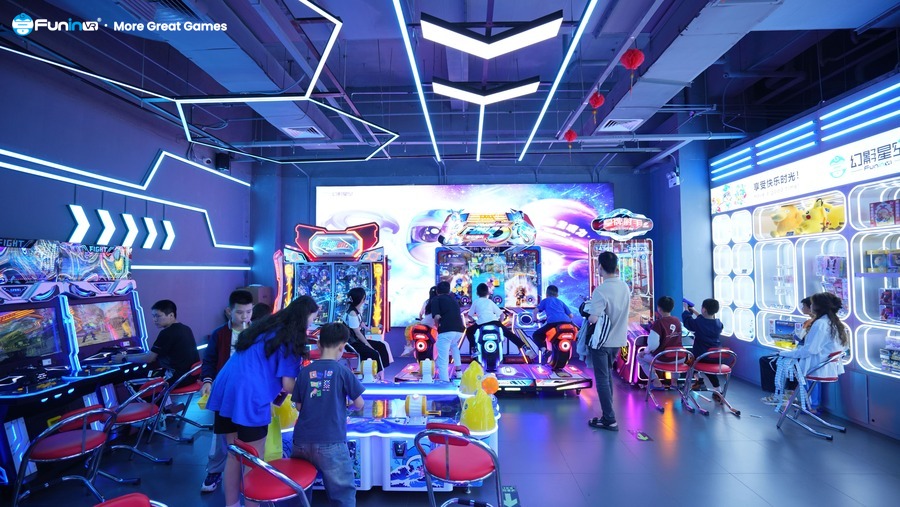
From Machines to Experiences
Modern arcades are no longer just spaces filled with machines — they are becoming experience-driven venues. VR entertainment solutions transform arcades from simple game spaces into immersive entertainment destinations.
Instead of offering isolated devices, VR solutions bring together VR Simulators, motion systems, interactive content, and operational platforms into a complete entertainment ecosystem. For players, this means deeper immersion and stronger emotional engagement. For operators, it means clearer monetization models, stronger repeat visits, and better long-term customer retention.
In a competitive entertainment market, experience value matters more than device quantity.
Designed for Commercial Operations
One of the biggest misconceptions about VR is confusing consumer products with commercial systems. Commercial VR equipment is specifically engineered for public venues. It focuses on durability, operational stability, safety standards, and high-frequency use.
In arcade environments, this matters. Equipment must run all day, handle continuous user turnover, and remain easy to operate for staff. Modern VR arcade systems are built with simplified workflows, standardized user flows, and modular structures that allow operators to manage multiple devices efficiently without complex technical training.
This makes VR not just exciting — but operationally realistic for arcades.
Experience Variety Drives Business Performance
Successful arcades are built on diversity. No single attraction can satisfy all players. This is why VR entertainment solutions work best when they are deployed as part of a mixed experience structure.
A well-designed VR arcade environment often combines:
-
Fast-entry VR shooting simulators for instant engagement
-
Competitive VR racing simulators for repeat play
-
Motion-based VR simulators for premium experiences
-
Compact VR arcade machines for high-traffic zones
This variety allows arcades to serve different age groups, play styles, and spending levels while maintaining a balanced revenue structure.
Content Is the Real Engine of Growth
Hardware attracts attention — but content drives long-term value. Arcades that succeed with VR are those that continuously refresh their experience library.
Modern VR entertainment solutions rely on evolving content ecosystems: game updates, new interactive experiences, seasonal themes, and localized content. This keeps the experience fresh and prevents user fatigue.
This is why solution-based providers are replacing traditional equipment suppliers. Companies that integrate content development, content integration, and system management enable arcades to grow without constant hardware replacement.
Scalable by Design
Another key advantage of VR entertainment solutions is scalability. Arcades don’t need to build everything at once. They can start with a small VR zone and expand gradually based on customer response and revenue performance.
This modular growth model reduces investment risk and allows operators to evolve their venue organically — transforming VR from a single attraction into a core business system over time.
The Role of Integrated Solution Providers
As the industry matures, arcades are no longer looking for single-product suppliers. They are looking for solution partners who understand system design, content ecosystems, and long-term operation.
Brands like ฟันอินVR represent this new generation of commercial VR providers — combining source manufacturing, multi-type VR equipment, arcade machines, content integration, and full-venue solution design. This system-level approach allows arcades to build flexible, scalable, and future-proof VR entertainment spaces rather than isolated installations.
So, are VR entertainment solutions suitable for arcades?
They are not just suitable — they are strategically aligned with the future direction of arcade entertainment.
VR entertainment solutions help arcades evolve from traditional game halls into immersive experience spaces. They strengthen customer engagement, improve commercial performance, and create sustainable growth models.
In today’s entertainment economy, VR is no longer a novelty attraction.
It is becoming a core infrastructure of modern arcades.